

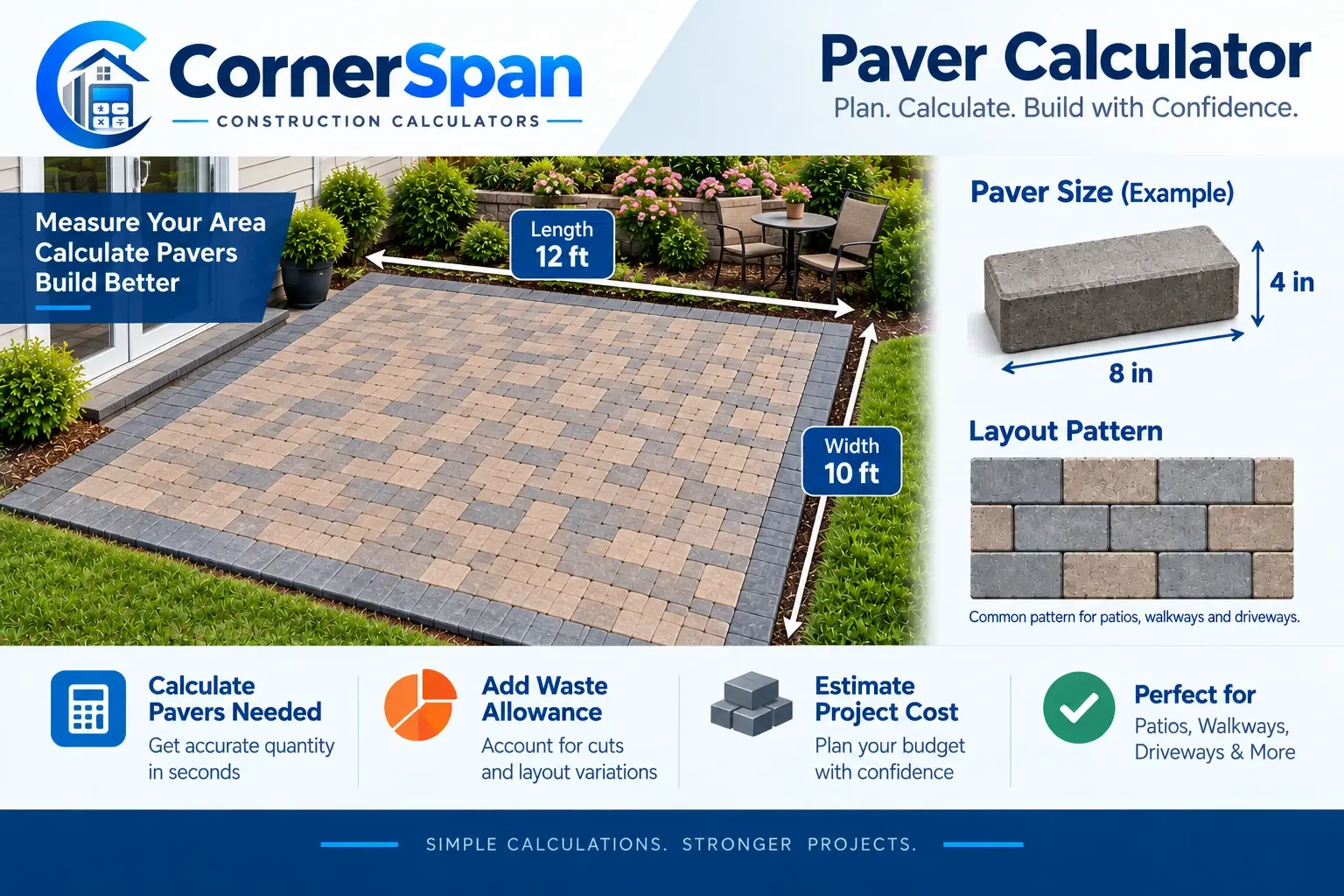
Calculate Pavers for Patios, Walkways and Driveways
A paver calculator estimates the number of paving units required to cover a measured surface. It is useful when planning a backyard patio, front walkway, garden path, pool surround or driveway. Accurate measurements help reduce material shortages and unnecessary leftovers.
Enter the length and width of your project, then enter the length and width of one paver. Select the appropriate measurement units and a waste allowance. The calculator estimates the number of units to order and can calculate an estimated paver material cost when you provide a price per paver.
The calculator supports feet, inches, meters and centimeters. Results are estimates, not a substitute for a site measurement or a product-specific installation plan. You can also use our Area Calculator to estimate surface area, or the Gravel Calculator to plan aggregate quantities separately.
How to Use the Paver Calculator
1. Measure the project
Measure the length and width of the area to be paved. Use consistent units and exclude spaces that will not receive pavers.
2. Enter paver dimensions
Use the actual length and width supplied by the manufacturer. Do not assume every paver has the same dimensions.
3. Select waste allowance
Choose an allowance based on cutting, the layout pattern, the shape of the area and possible breakage.
4. Review quantity and cost
Check the order quantity and enter the price per paver if you want a material-cost estimate.
Paver Calculator Formula
For a rectangular project using rectangular pavers, calculate the project area and the area covered by one paver in the same units. Divide the project area by the paver area, then apply the selected waste allowance.
Project area = Length × Width
Paver area = Paver length × Paver width
Exact quantity = Project area ÷ Paver area
Order quantity = CEIL(Exact quantity × (1 + Waste % ÷ 100))
CEIL means rounding up to the next whole paver. One square foot contains 144 square inches, and one square meter is approximately 10.764 square feet.
Example: Pavers for a 12 ft × 10 ft Patio
Suppose a rectangular patio measures 12 feet by 10 feet and you plan to use pavers measuring 8 inches by 4 inches. For this example, assume a 10% waste allowance.
Calculation: 120 sq ft × 144 = 17,280 sq in. Dividing 17,280 by 32 gives 540 pavers. Adding 10% gives 594 pavers. Actual cuts, joint spacing and product dimensions can change the quantity needed.
Common Paver Sizes and Coverage
This table uses the stated dimensions as actual coverage dimensions. It does not account for joint spacing, borders, cutting or waste.
| Paver size | Area per paver | Pavers per sq ft |
|---|---|---|
| 4 × 8 in | 0.2222 sq ft | 4.5 |
| 6 × 6 in | 0.25 sq ft | 4 |
| 12 × 12 in | 1 sq ft | 1 |
Actual product coverage can differ from nominal size. Check the manufacturer’s coverage information before placing an order.
How Much Extra Should You Order?
Waste allowance covers material lost to cutting, breakage and installation mistakes. The appropriate percentage depends on the project.
5%
Simple layouts
A possible starting point for rectangular areas with few cuts.
10%
General planning
A common planning allowance for straightforward projects.
15%+
Complex layouts
May be appropriate for curves, diagonal patterns or extensive cutting.
These percentages are planning examples, not guaranteed requirements. Follow the supplier’s recommendations.
How Paver Layout Patterns Affect Material Needs
Two patios with the same area can require different quantities if their layouts involve different amounts of cutting. The area formula estimates coverage, while the layout affects how efficiently whole pavers fit.
Running bond
Rows are offset from one another. Cuts may be needed at row ends and around obstacles.
Herringbone
This interlocking pattern may need extra cuts around borders and edges.
Diagonal and curved layouts
Angled edges and curves can create additional offcuts.
Calculating Pavers for Irregular Areas
If your patio or walkway is L-shaped, divide it into smaller non-overlapping rectangles. Calculate each rectangle’s area and add the areas together. For example, rectangles measuring 10 × 8 feet and 6 × 4 feet have a combined area of 104 square feet.
For circular, curved or highly irregular spaces, use suitable geometric measurements or a scaled layout. Subtract areas that will not be paved and avoid counting overlapping sections twice.
Estimating Paver Material Cost
Multiply the calculated order quantity by the price of one paver to estimate the cost of the pavers themselves.
Paver material cost = Order quantity × Price per paver
This estimate excludes delivery, labor, taxes, base aggregate, bedding sand, edging, drainage and equipment. Obtain local supplier and contractor estimates for a complete project budget.
What This Calculator Does Not Include
This calculator estimates paver quantity and optional paver material cost from rectangular dimensions. It does not design the paving system or determine the required thickness of the base, bedding layer or jointing material.
Those requirements depend on soil conditions, drainage, expected traffic, climate, paver type and local construction practices. Follow product installation instructions and applicable local requirements.
Paver Calculator FAQs
How many pavers do I need for a 100-square-foot patio?
With 4 × 8 inch pavers, 100 square feet requires 450 pavers before waste. A 10% allowance gives 495 pavers, assuming the stated dimensions represent the coverage dimensions.
How do I calculate pavers per square foot?
Divide 144 square inches by the area of one paver in square inches. An 8 × 4 inch paver gives 144 ÷ 32 = 4.5 pavers per square foot.
Does paver joint spacing affect the quantity?
Yes. Joint spacing affects the installed module size. Use the manufacturer’s coverage specifications when available.
Can I use this calculator for a driveway?
Yes, it estimates paver quantities for the measured surface. It does not determine whether the pavers or base system are suitable for vehicle loads.
Can I calculate pavers using metric units?
Yes. The calculator supports feet, meters, inches and centimeters.
Does the result include gravel and sand?
No. It estimates pavers and optional paver material cost. Use the Gravel Calculator for a separate gravel estimate. Bedding sand and jointing materials must also be estimated separately.
Should I order all the pavers at once?
Ordering together may help maintain color and batch consistency. Confirm quantities, returns and availability with your supplier before ordering.