

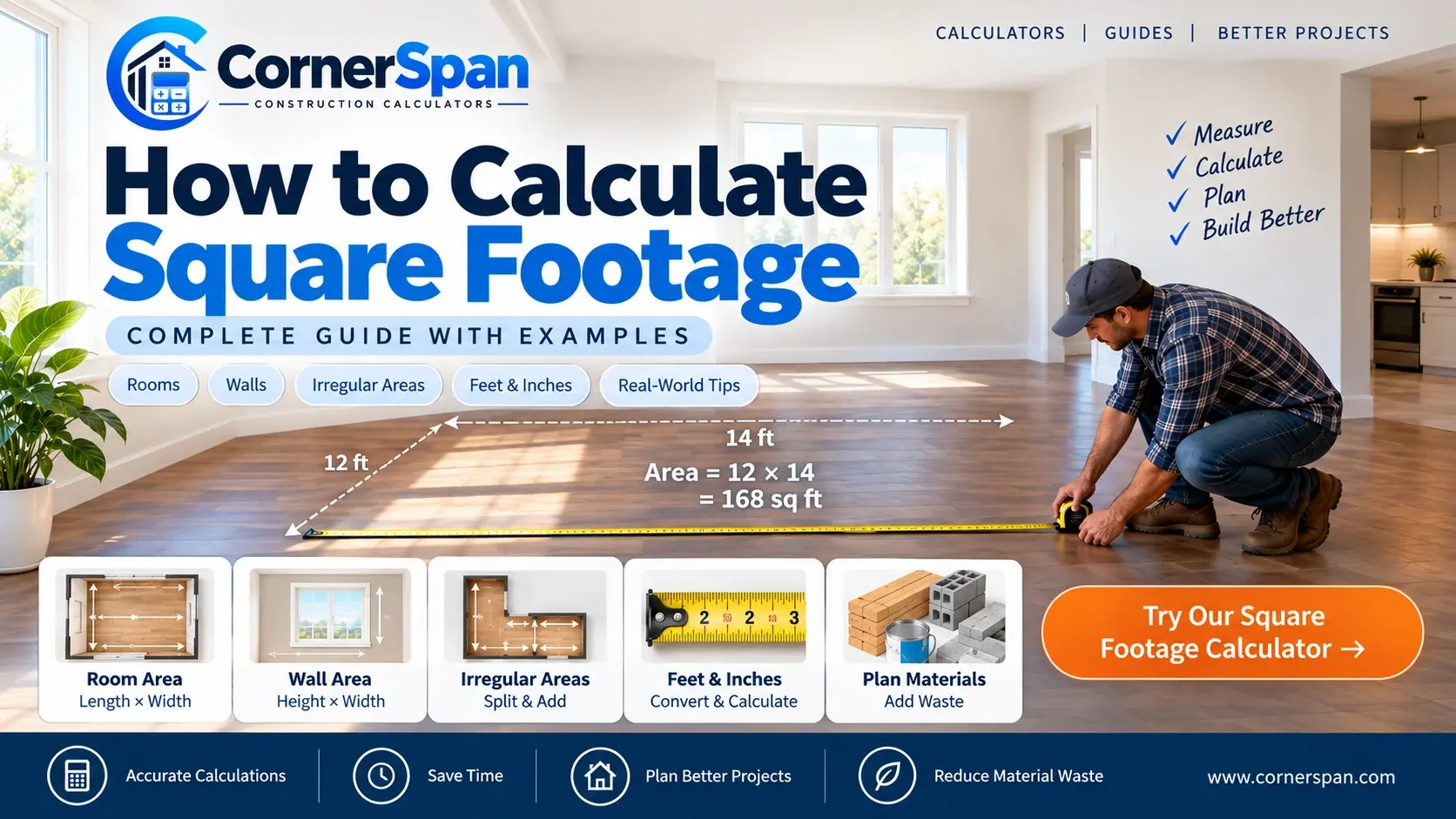
How to Calculate Square Footage
Learn how to calculate square footage for rooms, floors, walls and irregular areas. This guide covers simple formulas, feet-and-inches measurements, waste allowances and practical examples.
Try the Square Footage Calculator →Square footage is one of the most useful measurements for planning flooring, paint, tile, concrete, materials and other construction projects. Once you know the dimensions of an area, the basic calculation is usually simple.
How to Calculate Square Footage
For a rectangular area, multiply the length by the width. When both measurements are in feet, the result is measured in square feet.
Square Footage Formula
Square Feet = Length × Width
Square Footage Examples
Suppose a room is 12 feet long and 10 feet wide:
The calculation is:
12 × 10 = 120 square feet
How to Calculate Square Footage of a Room
Measure the inside length and width of the room. Keep the measurements in the same unit, then multiply them.
For example, a 15 ft × 20 ft room has:
15 × 20 = 300 sq ft
If a room has closets, alcoves or other sections that are not part of the main rectangle, calculate those sections separately and add them when appropriate.
How to Calculate Wall Square Footage
Wall area uses the same basic multiplication method, but the measurements are normally height and width.
Wall Area = Wall Height × Wall Width
For a wall that is 8 feet high and 12 feet wide:
8 × 12 = 96 sq ft
If the project involves painting or another finish, doors and windows may need to be subtracted from the total depending on how accurately you need to estimate materials.
How to Calculate Square Feet Using Feet and Inches
Measurements often include both feet and inches. Convert the inches to a fraction of a foot before multiplying.
- 1 inch = 1/12 foot
- 3 inches = 0.25 foot
- 6 inches = 0.50 foot
- 9 inches = 0.75 foot
For example, 10 feet 6 inches equals 10.5 feet.
If the other dimension is 12 feet:
10.5 × 12 = 126 sq ft
For more complex feet-and-inches measurements, use the CornerSpan Square Footage Calculator.
How to Calculate Square Footage for an Irregular Area
Not every room or floor has a simple rectangle shape. A reliable method is to divide the area into smaller rectangles, calculate each section, and add the results.
Example:
- Section A: 10 ft × 8 ft = 80 sq ft
- Section B: 6 ft × 5 ft = 30 sq ft
Total = 80 + 30 = 110 sq ft
This approach works well for L-shaped rooms and many other irregular layouts.
Common Square Footage Calculations
- Floor area: Length × Width
- Wall area: Height × Width
- Multiple rooms: Calculate each room and add the areas
- Irregular areas: Divide into simple shapes and add the results
Adding Material Waste
The calculated area is not always the amount of material you should purchase. Flooring, tile, siding and other materials can require additional material for cuts, breakage, pattern matching and installation.
A planning allowance of around 5% to 15% is common, although the appropriate amount depends on the material and project.
Example: 300 sq ft + 10% waste
300 × 1.10 = 330 sq ft
The additional amount is a planning allowance, not a guarantee of the exact material required.
How Many Square Feet Do I Need?
First calculate the actual area. Then consider whether the material is sold by square foot, square yard, box, roll, gallon or another unit.
Always check the manufacturer's coverage information when converting your square footage into a material quantity.
Tips for Accurate Square Footage Measurements
- Measure each dimension carefully.
- Use the same unit throughout the calculation.
- Measure irregular sections separately.
- Double-check unusual measurements.
- Keep the original measurements for reference.
- Add an appropriate material waste allowance.
Frequently Asked Questions
How do you calculate square footage?
For a rectangular area, multiply length by width. If the measurements are in feet, the result is square feet.
What is the formula for square feet?
The basic formula is:
Square Feet = Length × Width
How do you calculate square footage with inches?
Convert inches into feet first. For example, 6 inches is 0.5 feet, so 10 ft 6 in becomes 10.5 feet.
How do you calculate an irregular room?
Divide the room into smaller rectangles or other simple shapes, calculate each area and add the results.
Should I add waste to square footage?
For many material-planning projects, yes. A common starting range is 5% to 15%, depending on the material and project complexity.
Calculate Your Square Footage
Enter your dimensions and calculate square footage for rooms, walls, multiple areas, irregular spaces and more.
Open Square Footage Calculator →